How to build a product people will pay 100x for in an AI World
What a cup of coffee teaches founders, PMs and CEOs about escaping commoditization, especially now that AI is turning software into raw beans.
Most founders, PMs, Marketers and CEOs I know spend a lot of time on “Who am I selling to?” Important question – but underneath it is another one which ultimately decides whether or not you get stuck in a price war:
What am I actually selling?
The best framework I know for answering this is almost 30 years old. In a 1998 Harvard Business Review article, later expanded into the book The Experience Economy, B. Joseph Pine II and James H. Gilmore described the Progression of Economic Value.
It’s a ladder that goes from commodities to goods, then services, then experiences, and finally – transformations. On each step up, customers pay more and think less about the price.
Here’s an easy example featuring your most heavily used psychoactive drug:
The coffee ladder
The beans in your morning cup cost about 3 cents. Even so, people happily pay anywhere from 3 cents to several dollars for roughly the same caffeine. They’re not being irrational.
They’re buying different things.
If you buy a 10kg burlap sack of green beans, you’re buying a commodity. It’s a raw crop, about 3 cents a cup, and no different from every other sack on the dock.
If you pick up a branded bag of ground coffee at the supermarket, you’ve bought a good. Someone roasted it, ground it and packaged it – now it’s about 15 cents a cup.
Sit at a diner counter while a friendly waitress keeps refilling your mug – you’re getting a service which will cost you about a dollar or two.
Order a “Pumpkin Spice Latte” at Starbucks, with cinnamon smell, jazz music in the background, sofas you can chill on and your name misspelled on the cup, – now you’re paying $5+ for an experience.
The coffee barely changed on the way up. What changed is everything wrapped around it.
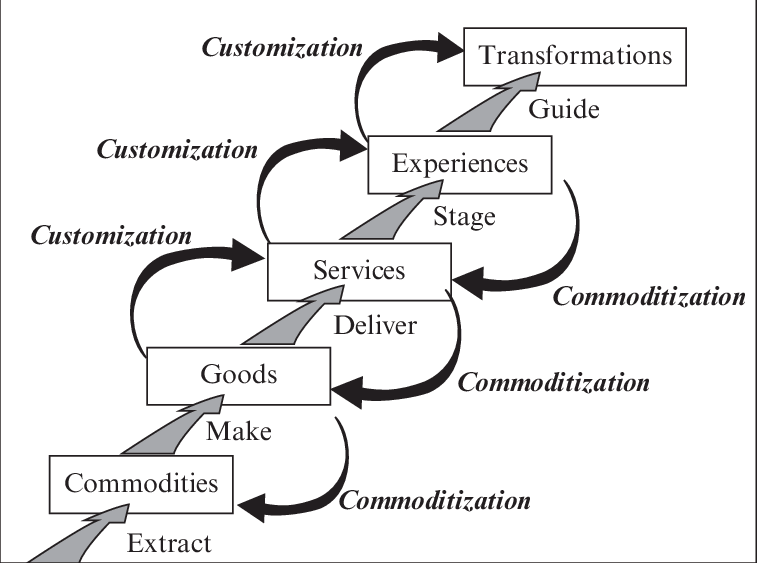
But the top rung is where it gets interesting – at the top of this ladder – the cup is part of something bigger.
Imagine a functional focus coffee blend with MCT oil and Lions Mane – delivered as a subscription that arrives at your door, syncs with your sleep tracker, tells you when to drink and when to stop and adjusts the formula as your focus improves. You may be paying $15 a cup but you’re no longer paying for coffee;
You’re paying to become the person who does their best work before noon. A transformation isn’t a better cup. It’s a better you. That’s a transformation.
- COMMODITY ($0.03) ► “A sack of raw green beans”
- GOODS ($0.15) ► “A branded bag of roasted beans”
- SERVICE ($1) ► “Someone brews it and it just keeps coming”
- EXPERIENCE ($5+) ► “Drinking this coffee here is fun”
- TRANSFORMATION (priced per outcome) ► “I become someone new”
–> What each rung means for the seller
Commodity: Huge volume and zero pricing power. The market sets the price, which over time becomes a race to the bottom.
Goods: Scalable and brandable. You’re also always one discount or store brand away from a fight over shelf space.
Services: Better margins, because people pay for convenience. But services depend on people (or increasingly – agents), which makes them fragile. When things go wrong you create what Pine and Gilmore call customer sacrifice – the gap between what customers wanted and what they settled for. That’s a risk you’re taking.
Experiences: You’re charging for a) time spent and b) dopamine – not for coffee. Starbucks is renting you a table and a vibe. The catch is that novelty fades and once everyone stages the same experience, experiences get commoditized too.
Transformations: This is the strongest moat on the ladder. As Pine puts it – here the customer is the product. The thought of cancelling induces FOMO because it would mean giving up on a better version of yourself – and that’s a hard thing to walk away from.
The catch with transformation is that you have to keep pushing the envelope and actually deliver the change customers expect; if change doesn’t happen – the whole thing falls apart.
Good products must climb: the iPhone
The first iPhone in 2007 provided a revolutionary experience – pinch-to-zoom felt like magic and apps at your fingertips felt like productivity unlocked. Today every phone can do that. What Apple increasingly sells is the stuff that changes your behavior: tracking your sleep, nudging your screen time, keeping your health records and helping you at work.
The hardware gets commoditized but the guidance it provides doesn’t. Apple will never finish the climb because consumers expectations keep growing and the market baseline keeps catching up.
The AI token trap
This is why the ladder matters right now. AI is sliding down it faster than anything I’ve seen.
Three years ago, a model that could write a decent paragraph was such an experience I’d sometimes screenshot and share the results.
Today, raw tokens are green coffee beans. Prices keep dropping, every model gets matched within weeks and a thin wrapper around an API is just a branded bag of beans on a crowded shelf.
At Ensemble (my last startup focused on AI Infrastructure for Developers building agents) we experienced this firsthand – watching some of the cutting-edge tools and capabilities we built from scratch become redundant within months… sometimes weeks…
If the product you sell leverages AI for your customers – here are three questions worth asking yourself and your team:
- If within a year customers will be able to generate our output themselves with an off-the-shelf model – what will they still be paying us for?
- Are we just answering prompts, or do we understand the customer’s context well enough to move them toward a result?
- Would people miss what we built, or is it a utility they’d swap for something cheaper tomorrow?
Where AI value will pool
I see two places – and both sit at the top of the ladder.
Context. The product knows you: your goals, KPIs, processes and history and it gets sharper every time you use it. It feels like it was made for you and pushes customer sacrifice toward zero. Second, it knows the world better than anyone else, because its data is more real-time, more accurate and more complete. A marketer doesn’t just need an AI that understands their funnel. They need one that sees what’s happening in their market right now. They need something proprietary. A competitor can rent the same model, but they can’t rent your users’ history or data. Data anyone can buy is just another sack of beans.
Outcomes. Instead of charging for seats or tokens, you own the result. You take responsibility for a workflow end to end, guarantee it and absorb the risk. Customers will pay a lot to stop worrying. This is the transformation rung for B2B: the customer isn’t buying software, they’re buying a version of their company that runs better.
The winning approach
Earlier this year, software stocks took a beating as the market realized AI can copy more and more software. Tech Twitter (aka X) called it the SaaSpocalypse. Monday.com lost about half its value in six months as investors asked a hard question: if any company can spin up its own project management tool, what are customers paying for? Even Salesforce, with its hundreds of integrations and decades of customer data, dropped over 40%.
Why would even Salesforce get hit? Because it shows what a moat actually is: the cost of leaving. There are two ways to raise that cost.
- Walls make leaving painful: integrations, migrations, processes built around your tool.
- Pull is when the customer wants your sweet nectar like a butterfly wants a flower – its when your customers choose to stay because your product makes them better than they’d be without it.
AI is picking at the walls, since agents can now move data and rebuild workflows in weeks. It’s your job to do whatever it takes (including leveraging AI) to increase your pull.
But pull isn’t permanent either. The ladder behaves like a down escalator and every rung keeps sliding toward commodity. Pinch-to-zoom was magic in 2007 and a checkbox by 2010. Competitors catch up and so do your customers. The transformation that amazed them last year is what they expect by default this year. If you stand still, you’re moving down.
Walls buy you time. Transformation is what you keep building with it.
Founders: Don’t build on the bottom rung. If your product is a wrapper, ask what it knows that the model doesn’t and what outcome you could own.
PMs and designers: Go looking for customer sacrifice. Every place a user settles is a chance to personalize and every personalization adds pull.
CEOs: Audit your moat honestly. How much of your retention comes from walls and how much from pull? Assume the walls are shrinking. Pick your next rung before a competitor picks it for you.
Pine’s challenge to executives still holds: stop asking what you make, and start asking what business you’re really in.
Because the top of the ladder isn’t only where you survive. It’s where you set the price.
Nobody comparison-shops a transformation. A competitor can undercut your coffee, your service, even your cafe, but they can’t undercut who your customer becomes.
That’s why people pay 100x.
They’re not paying for more coffee. They’re paying for something no one else on the shelf is selling.
Further reading
-
- B. Joseph Pine II & James H. Gilmore, “Welcome to the Experience Economy”, Harvard Business Review, 1998
- B. Joseph Pine II & James H. Gilmore, The Experience Economy
Be First to Comment